Development sites
Could your property be a development site?
We sell new homes for developers, so we know what they look for and who is buying sites.
 Powered by eXp New Zealand Licensed REAA 2008
From the first plans to the last key
Talk to us about your site
$550m+
of property worked on over our careers, new homes and at auction
17+ years
in property between us, New Zealand and Australia
100%
focused on new builds, from the first plans to the last key
When you ask us
What happens when you ask.
A free look
Send us the address. There is no charge and nothing to sign, and we call you within one working day.
A visit within 7 days
We walk the site with you and look at what the planning rules allow.
A straight answer in 3 working days
Whether your site has development potential under the planning rules as they stand, told plainly. No figure until there is evidence for one.
A figure in writing, and a feasibility report
Want a figure? We'll put our appraisal in writing, with the evidence behind it. If we can see real potential, we'll talk with you about getting a proper feasibility report done, because that's what tells us both what your site could really sell for.
Three options, one recommendation
Sell, hold or develop, with our recommendation, and written advice to talk to your own lawyer and accountant.
A quiet approach to developers
Your site goes to developers we know only once you have signed with us, and it goes quietly. You get a copy of what you sign within 48 hours. We act for you, and we tell you in writing about any interest we have.
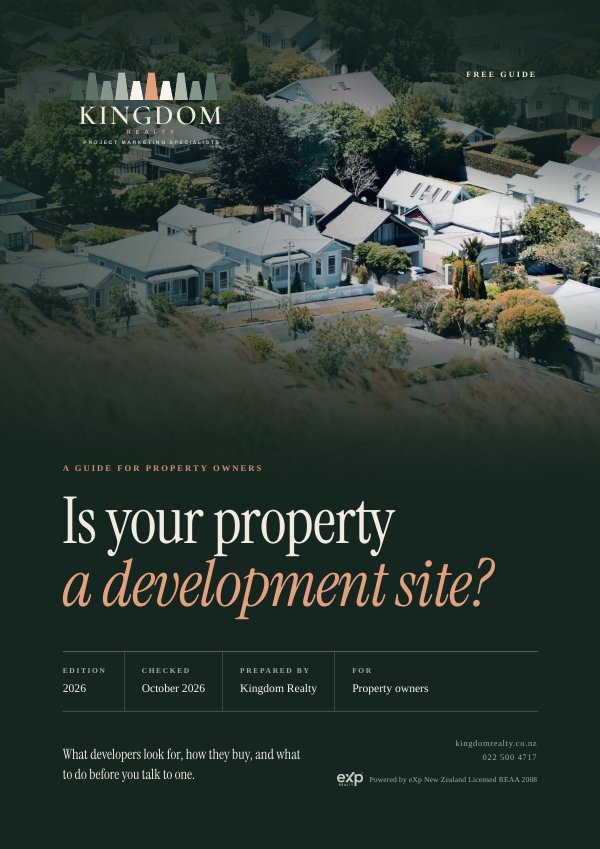
Free guide for owners
Is your property a development site?
What a developer looks at in a site, how offers are structured and sold, and what to gather before you talk to one.
- What a developer is paying for
- The eight things a developer checks first
- Auckland's planning rules and what is changing
- How developers structure an offer, and how a site is sold
What makes a good site
What a developer looks for.
The house matters less than the land it sits on. These are the things a developer's feasibility checks first, and the things that take value off a site.
- The zoneMixed Housing Urban or Terrace Housing and Apartment Buildings zoning is the strongest signal. Mixed Housing Suburban can still work. Single House zoning rarely does.
- SizeMost developers want at least 600 to 800 m² for a terrace or townhouse project. Bigger sites draw more bidders.
- Shape and frontageA regular, roughly rectangular section with a wide street frontage gives the most design room. Corner sites are prized. Narrow or odd-shaped land is harder to plan and worth less.
- SlopeFlat or gently sloping land builds cheaply. A steep site means retaining walls, earthworks and engineering, and every dollar of that comes off the land price.
- ServicesWater, wastewater and stormwater have to reach the site with capacity to spare. If the wastewater line needs upgrading, that can be a six-figure cost before a single home is built.
- Overlays and hazardsFlood plains and overland flow paths, volcanic viewshafts, heritage and special character areas, and notable trees all limit what can be built. The flood rules tightened in November 2025.
- The house on itA sound house that can be rented while consents are worked through offsets a developer's holding costs. A derelict one is only a demolition bill. Past industrial use can mean contamination to clean up.
- LocationNear a town centre, a train station or a busway stop is where the denser zoning sits and where new homes sell fastest.
| Auckland zone | Height | Site coverage |
|---|---|---|
| Mixed Housing Suburban | 8 m, about two storeys | 40% |
| Mixed Housing Urban | 11 m, about three storeys | 45% |
| Terrace Housing and Apartment Buildings | 16 m, five to six storeys | 50% |
Operative Auckland Unitary Plan standards. Up to three homes on a site are permitted in all three zones. Four or more homes on a site need a resource consent in every zone, which is how most townhouse projects are built. The medium density standards were withdrawn in Auckland in October 2025 and Plan Change 120 is still in hearings, so the rules for a given site should be read on the day.
Send us the address
Send us the address. We will look at what the planning rules allow and what the site itself can take, and tell you plainly what they appear to allow. If the site may suit a development, and only with your agreement, we can introduce it to developers we work with; before we do, we explain how we would act and who would pay us. If it does not, we will say so, and you will know where you stand.
Now
The address and two minutes
Within days
What the planning rules allow
Then
An introduction to developers, if you agree
Kingdom Realty
From the first plans to the last key.